
Vendor Choice pricing solves one of the most persistent problems in a multi-vendor store: not every vendor wants to participate in dual pricing, but your store still pays the processing fee when that vendor’s merchandise is bought with a card.
With Vendor Choice, vendors are not required to participate. Each vendor decides how the card processing cost on their sales is handled — and either way, your store is not left absorbing the fee.
How Vendor Choice works
Once your store is set to Vendor Choice, every vendor falls into one of two groups.
| Vendor status | What happens to their merchandise |
|---|---|
| Participating (opted in) | Their merchandise uses dual pricing. Tags display the single card price, and customers paying cash or check automatically receive the cash discount at checkout. The card price covers the processing cost. |
| Not participating (opted out) | Their merchandise stays traditionally single-priced. Tags display the single cash price and the customer pays the same amount whether they use cash or a card. When that merchandise is bought with a credit card, the applicable card fee is charged to the vendor through their Syncrostore account rather than absorbed by the store. |
In other words: vendors are not required to opt into dual pricing, but opting out does not shift the cost of their card transactions back to your store. That gives vendors a real choice while letting you keep one consistent policy for recovering processing costs.
Your three store pricing options
Vendor Choice is one of three settings your store can be in. Only one applies at a time.
| Option | What it does |
|---|---|
| Percentage Pricing | Dual pricing applies to every vendor in the store. Labels show the credit price, with the cash discount applied automatically at checkout. No vendor can opt out. |
| Vendor Choice Pricing | Each vendor chooses how card fees are handled. Participating vendors use dual pricing; non-participating vendors stay single-priced and are responsible for the applicable card fees on their own card sales. |
| Off | Traditional single pricing, with no dual-pricing adjustment anywhere in the store. |
Turning Vendor Choice on
Vendor Choice is a store-wide setting, changed once by an owner or admin.
- Go to Admin → Preferences.
- Find your credit card pricing method — the setting currently showing Percentage Pricing or Off.
- Change it to Vendor Choice.
- Confirm your card percentage is correct. This is the same percentage Vendor Choice uses for both participating and non-participating vendors.
- Save.
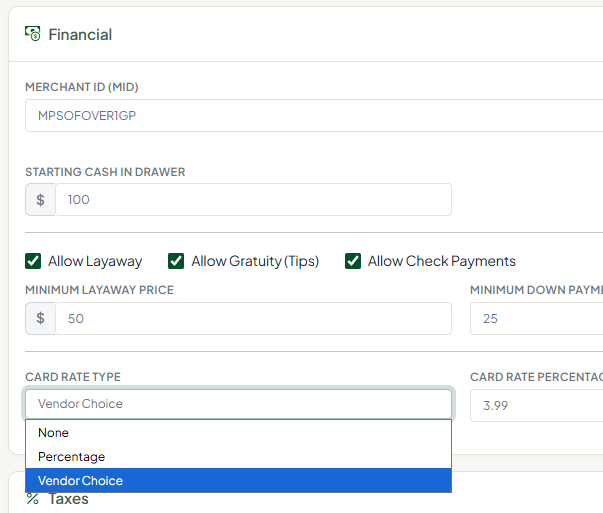
Changing this setting takes effect immediately at the register. Before you switch, read “Rolling it out to your vendors” below — participating vendors may need time to retag merchandise already on the floor.
Each vendor has to opt in individually
Turning on Vendor Choice does not opt anybody in. Every vendor starts out not participating, and each one has to be opted in individually. That is the whole point of the feature — it is a choice, made per vendor.
Owners and admins manage participation from the Vendor details screen:
- Open Vendors and select the vendor.
- Find the Vendor Choice participation setting on their details screen.
- Turn it on for a vendor who has agreed to participate; leave it off for one who has not.
- Save.
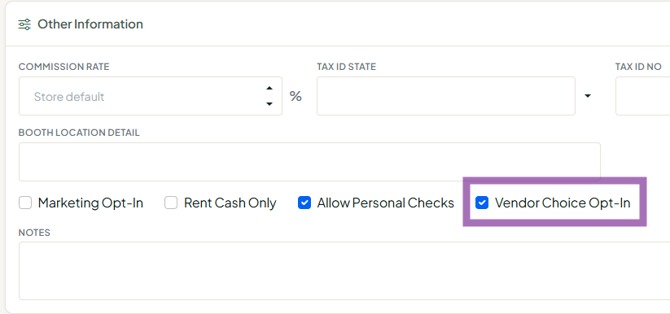
A few things worth knowing about opt-in:
- Every vendor defaults to not participating. A vendor you have never touched is treated as opted out, and card fees on their sales are charged to them.
- It is per store. A vendor who sells in two of your locations is set separately in each.
- You can change it at any time, but a change affects sales going forward, not sales already rung. If a vendor switches, their existing tags may no longer show the right price — see the tag article linked at the end.
The Tag Calculator
The Tag Calculator is the tool your vendors will use most, especially the ones who handwrite tags. It uses your store’s actual tax rate, card-pricing method and card percentage — and in a Vendor Choice store, it knows whether that individual vendor is participating, so the number it gives is already correct for them.
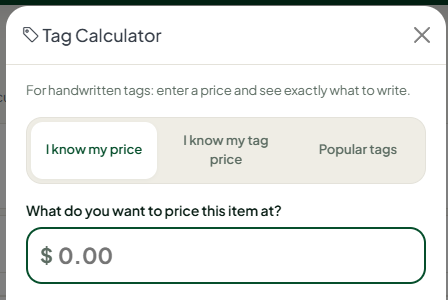
It has three tabs.
1. “I Know My Price”
The vendor enters the amount they want to earn for an item, and Syncrostore calculates the single credit price to write on the tag — with a full breakdown of the math, so they can see exactly where the number came from.
For a vendor who has chosen not to participate, this tab instead shows “You could be earning…” — a side-by-side of how much more they would keep from card-paying customers by participating, rather than paying the card fee themselves. It is the most useful screen you have for explaining the choice to a hesitant vendor.
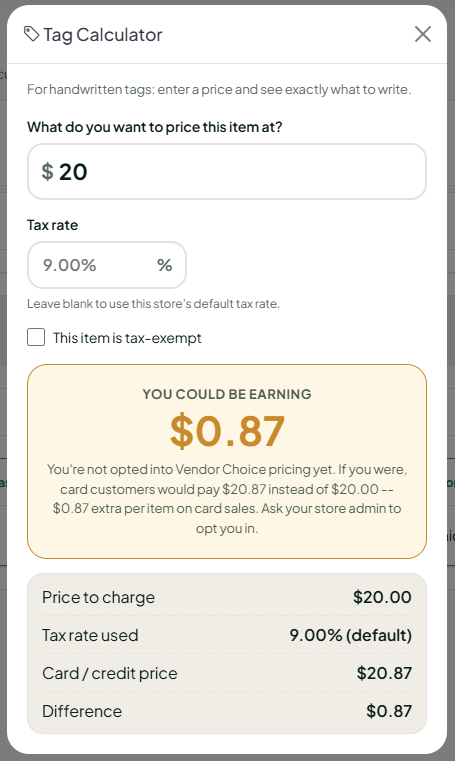
2. “I Know My Tag Price”
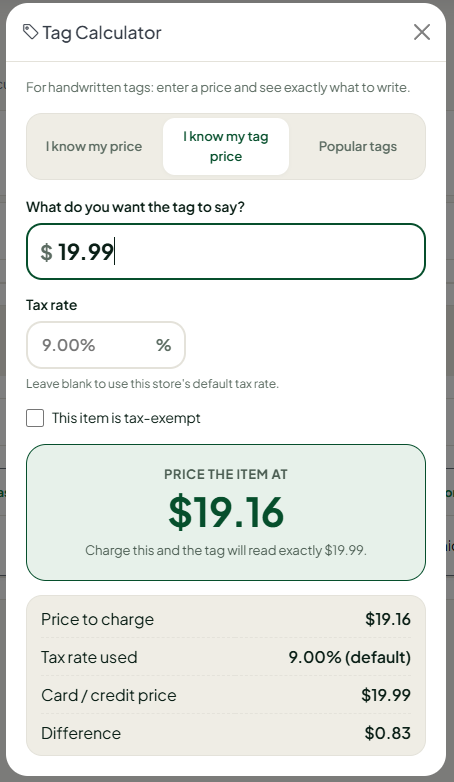
Sometimes a vendor wants the tag to land on a specific number — $19.99, say. They enter the price they want displayed, and Syncrostore works backward to find the underlying selling price that brings the final credit price as close as possible to that amount.
3. “Popular Tags”
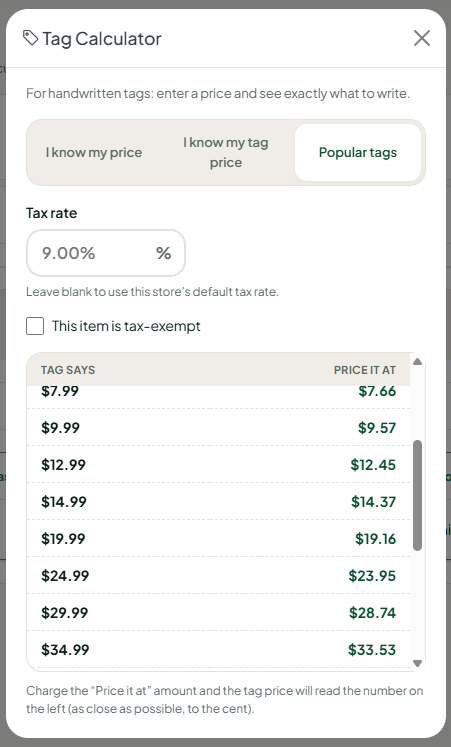
For a vendor pricing a large batch, Popular Tags lists common retail price points — $9.99, $19.99, $29.99, $49.99 and more — with the appropriate underlying price already calculated for each. Instead of running items one at a time, they can just reference the table as they price.
Adding an inventory item shows what the tag will say
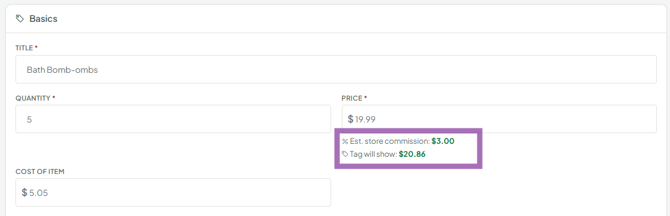
Vendors and staff entering inventory do not have to work any of this out for themselves. When you add an inventory item, Syncrostore shows what the tag will say for that item — the actual price that will print, calculated from the item’s price, your store’s pricing method and, in a Vendor Choice store, that vendor’s participation status.
This is worth pointing out to vendors during the transition, because it answers the question they will ask most often: “what number do I put on the tag?” The answer is on screen at the moment they enter the item.
What happens at checkout
A single transaction can contain merchandise from vendors who participate and vendors who don’t. Syncrostore handles all of it automatically.
- Participating vendor: the item’s card price applies when the customer pays by card. If they pay cash or check, the cash discount is applied automatically.
- Non-participating vendor: the item’s normal price applies regardless of tender. If the customer pays by card, the applicable card fee is charged to that vendor rather than passed to the customer.
The cashier never needs to know which vendors participate, separate transactions, calculate fees, or make adjustments. Syncrostore applies the right pricing and fee treatment to each item.
On a split payment — part cash, part card — the fee charged to a non-participating vendor is based on the share of the whole transaction that was actually paid by card.
Label printing is automatic
Standard labels, batch printing, custom label sizes, Label Designer — every item prints with one price, and Syncrostore picks the correct one.
| Store setting | Price that prints |
|---|---|
| Store-wide dual pricing (Percentage Pricing) | Card price |
| Vendor Choice — participating vendor | Card price |
| Vendor Choice — non-participating vendor | Normal price |
| Dual pricing turned off | Normal price |
There is no longer any need to print separate cash and credit prices on a label.
Rolling it out to your vendors
If your store is moving to Vendor Choice, give vendors about 30 days before the change takes effect. Participating vendors may need time to retag merchandise already on the sales floor. Announce on September 1, for example, and set October 1 as your effective date.
During the transition period:
- Explain Vendor Choice to your vendors.
- Give each vendor the opportunity to decide whether to participate.
- Establish and communicate a firm effective date.
- Give participating vendors time to retag existing merchandise with the new single credit price.
- Encourage vendors to use the Tag Calculator when preparing handwritten tags.
- Remind vendors that after migration, only one price should appear on their merchandise.
Note: existing two-price dual pricing tags will still scan just fine. Whether those printed prices remain accurate after a move to Vendor Choice depends on whether that vendor is opted in.
Common questions
If I turn on Vendor Choice, are my vendors automatically enrolled?
No. Every vendor starts out not participating. You opt each one in individually from their Vendor details screen, after they have agreed.
What happens to a vendor I never get around to setting?
They are treated as not participating. Their merchandise stays single-priced, and card fees on their sales are charged to them rather than to the store.
Can a vendor change their mind later?
Yes. Change the setting on their Vendor details screen. It applies to sales from that point forward — and their existing tags may need to be redone, since the correct tag price is different for the two statuses.
Does the cashier have to do anything differently?
No. The register applies the right price and the right fee treatment per item, including on a cart that mixes participating and non-participating vendors.
What if a vendor sells in more than one of my stores?
Participation is set per store. Set it in each location.
My store shows one price on the tag now and vendors are asking why.
See Why does my dual pricing store only show one price on the tag now?