The seven lines
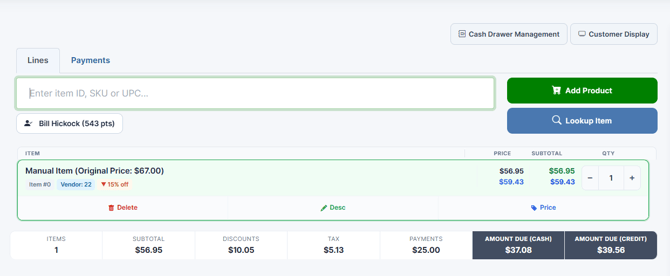
| Line | What it is |
|---|---|
| ITEMS | The total number of units, not the number of lines. Three of one item counts as 3 |
| SUBTOTAL | The cash subtotal, already reduced by any discounts |
| DISCOUNTS | How much has been discounted. Shown for information — it is not subtracted again |
| TAX | Tax on the taxable lines |
| PAYMENTS | What's been tendered on this sale so far |
| AMOUNT DUE (CASH) | What's left to collect — see the rule below |
| AMOUNT DUE (CREDIT) | What's left to collect at the card price |
The most common question about this panel is why SUBTOTAL doesn't drop when a discount is applied. It already has — SUBTOTAL is the discounted figure, and the DISCOUNTS line is telling you how much came off to get there.
Which lines never carry tax
Four kinds of line contribute nothing to TAX, whatever your tax rates are:
- Items flagged tax-exempt in inventory
- Layaway lines
- Rent payments
- Gift cards being sold
And if the customer on the sale is set up as a reseller, TAX is $0.00 for the whole sale — see How Tax Exemption Works at the Register.
Dual pricing: the rule that surprises people
If your store is on dual-pricing, every item shows two prices — the cash price and the card price — and the totals panel shows two amounts due.
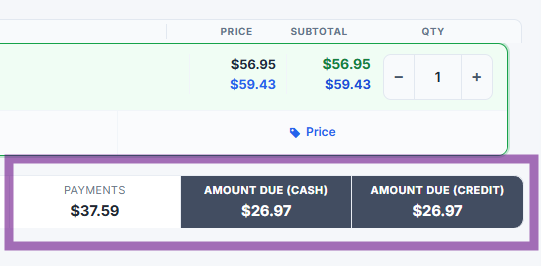
Once any part of a sale has been paid by card, the whole sale is priced at the card total — including anything still owed.
So after a customer puts $20 on a card, both AMOUNT DUE lines show the same number. That is correct. Mixing a card into the sale forfeits the cash price for the whole sale, not just the card portion.
The label still reads "AMOUNT DUE (CASH)". Only the number changes. Collect what that line says and the sale will balance.
What this means in practice
If a customer wants the cash price on part of a sale, take the cash first. Cash tendered before any card payment is collected at the cash price. Once a card lands, everything after it is at the card price.